
Inland Empire Man Gets 30 Months in $7.2 Million Cargo Ring That Ran Loads Through Bought Trucking Companies
The same sheriff's investigation produced the Los Angeles case in which a jury convicted two men in September. Four of his co-defendants go to trial in March.
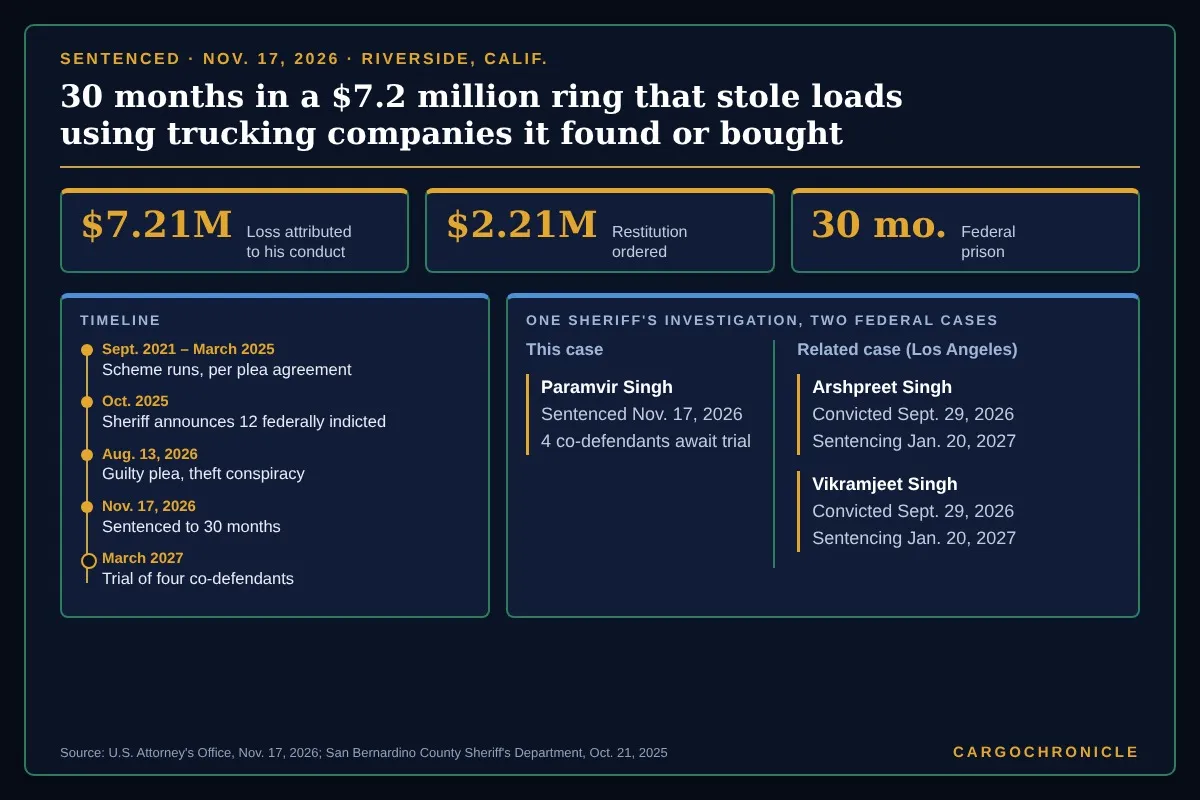
RIVERSIDE, Calif. — A Rancho Cucamonga man was sentenced Nov. 17 to 30 months in federal prison for his part in a ring that picked up shippers’ loads under trucking companies it found or bought and never delivered them. Prosecutors attributed about $7.2 million in losses to his conduct. His case came out of the same San Bernardino County sheriff’s investigation that produced the September convictions of two men in a Los Angeles trial over a similar scheme.
Paramvir Singh, 30, pleaded guilty Aug. 13 to one count of conspiracy to commit theft from interstate or foreign shipments. U.S. District Judge Kenly Kiya Kato imposed the sentence and ordered him to pay $2,210,055 in restitution.
According to his plea agreement, as described by the U.S. Attorney’s Office, Singh and his accomplices found or purchased trucking companies from September 2021 to March 2025 and enrolled them with freight brokers and load boards. They drove to shippers in trucks that typically bore the company’s name, signed agreements to deliver the cargo to a set place by a set date, often in another state, and loaded it into their trailers. Then they stole it. The office listed shippers in Walnut, Moreno Valley, Fontana and Chino among the victims but did not name the companies or the goods taken.
Four co-defendants, men ages 28 to 41 from San Bernardino, Fontana and Bakersfield, are set for trial in March 2027. They have not been convicted and are presumed innocent.
One investigation, two prosecutions
In October 2025, the San Bernardino County Sheriff’s Department announced that its investigation of a group it called the “Singh Organization” had produced federal indictments against 12 people. Its list included Singh and all four of his co-defendants. It also included Arshpreet Singh and Vikramjeet Singh, the two men a federal jury in Los Angeles convicted on Sept. 29 in a separate case over a $2 million scheme. Prosecutors in that trial said the ring bought established carriers, two of them through Facebook Marketplace listings, and booked real loads under their names.
The sheriff’s department described the group as acquiring or fraudulently using legitimate trucking companies to win shipping contracts, then diverting the freight, mainly electronics, appliances and other high-value consumer goods, between March 2021 and June 2025. It put the losses in the millions of dollars.
The two federal cases were charged separately and are before different judges, and prosecutors have not described them as a single conspiracy. But the method, the region and the investigators line up. Both involve the FBI’s Inland Violent Crime Suppression Task Force, IRS Criminal Investigation, the Fontana Police Department and the San Bernardino and Riverside county sheriff’s departments. Arshpreet Singh and Vikramjeet Singh are scheduled to be sentenced Jan. 20, 2027.
The restitution order covers less than a third of the loss attributed to Singh: $2.21 million against $7.21 million. The office’s announcement does not explain the difference, and the plea agreement and judgment were not reviewed for this article.
The national picture
Overhaul counted 629 cargo thefts in the U.S. in the third quarter of 2026, 8% fewer than a year earlier. Verisk CargoNet, which tracks the U.S. and Canada together, recorded a steeper drop, 33%, to 547 incidents.
Why it matters
A carrier that changes hands keeps its operating authority, its safety record and its broker relationships. That is what made this method work for at least three and a half years: each load went to a company that looked established because it was. Vetting that stops at an active authority and a clean history will pass it. The checks that catch it look for change: new owners or officers, a new email domain, phone number, bank account or dispatch contact, or a carrier suddenly hauling freight it never hauled before. A tender procedure that treats any of those as a reason to verify through contact details already on file, and brokers who share non-delivery reports with each other rather than absorbing them, shorten how long a bought carrier can keep working.
CargoChronicle will follow the co-defendants’ trial in March and the January sentencing in the Los Angeles case.
Related coverage
This article is part of an ongoing case we are following.
See the full timeline for this case — every article in order, oldest first.
Sources
- U.S. Attorney's Office, Nov. 17, 2026
- San Bernardino County Sheriff's Department, Oct. 21, 2025
- U.S. Attorney's Office, Sept. 29, 2026
- Overhaul, Q3 2026 U.S. cargo theft report
- Verisk CargoNet, Q3 2026 cargo theft data