
Jury Convicts Two in $2 Million Freight-Theft Ring That Bought Real Trucking Companies
Prosecutors said the ring bought licensed carriers, two through Facebook Marketplace, then booked real loads under their names and never delivered them.
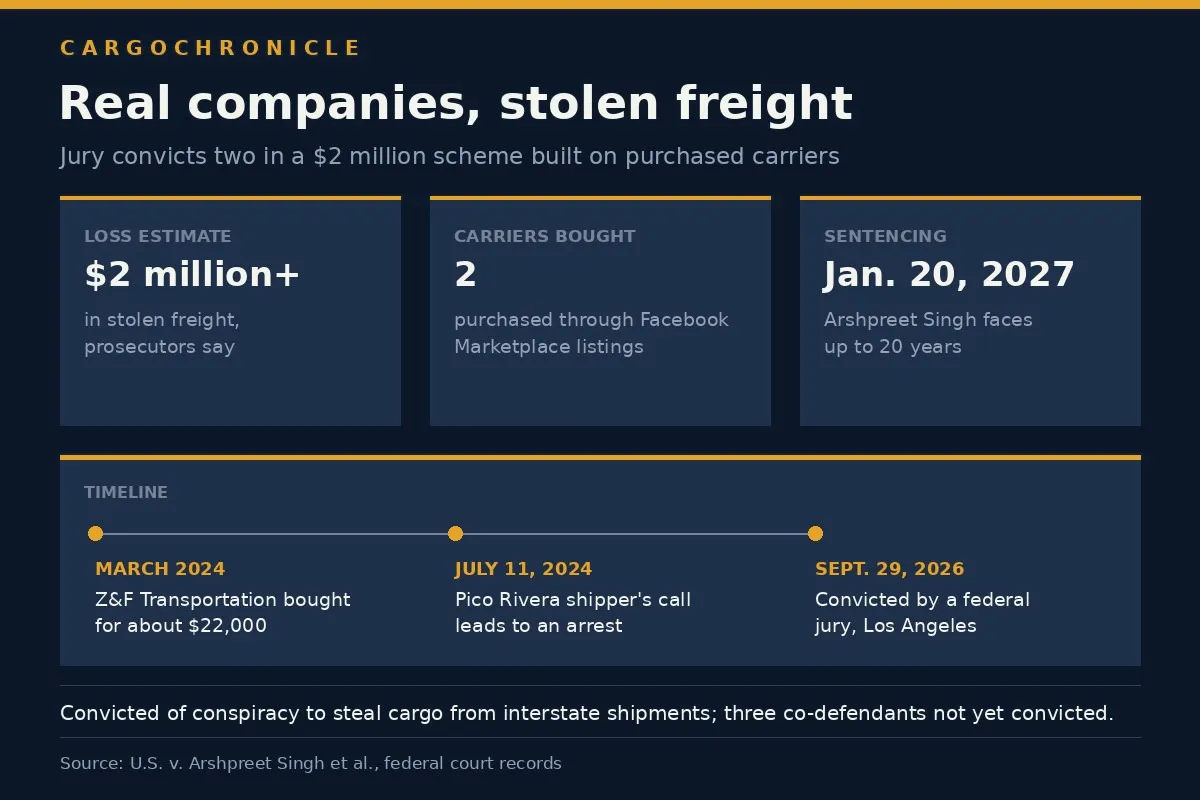
LOS ANGELES — A federal jury on Sept. 29 convicted two men of conspiring to steal cargo from Southern California warehouses in a scheme that, prosecutors said, ran on established trucking companies the ring bought or took over. Members booked genuine loads under those companies’ names, picked up the freight and never delivered it. The U.S. Attorney’s Office estimated losses at no less than $2 million.
The U.S. Attorney’s Office identified the men as Arshpreet Singh, 28, of Sacramento, and Vikramjeet Singh, 31, of Fontana. Arshpreet Singh was found guilty of conspiracy to commit wire fraud and conspiracy to commit theft from interstate shipments. Vikramjeet Singh was found guilty of the theft conspiracy and acquitted of the wire fraud count. The verdicts followed a seven-day trial before U.S. District Judge Anne Hwang, who set sentencing for Jan. 20, 2027. Arshpreet Singh faces up to 20 years in federal prison and Vikramjeet Singh up to five, according to the office.
According to prosecutors, the conspiracy ran from March 2024 to at least June 2025. Its members bought licensed carriers or posed as their owners, enrolled the companies with load boards and freight brokers, rented trailers, and arrived at shippers’ docks in tractors marked with the carrier’s name. They signed for loads headed out of state and drove off. Thefts were reported in Fontana, Vernon, Santa Fe Springs, Perris, Long Beach, Compton, Pico Rivera, Chino, Moreno Valley and other Southern California cities, as well as Grand Prairie, Texas. The cargo included televisions, laptops, vacuums, solar panels, LED lights, shoes and tires.
The government’s trial memorandum, whose factual account the defense disputed, describes how the companies changed hands. The owner of Z&F Transportation, a Texas carrier, listed it on Facebook Marketplace in March 2024. Prosecutors said Arshpreet Singh met him at a hotel in Denton, Texas, paid cash and took over the company’s email logins; the office put the price at about $22,000. Ten days later, a load of LG televisions booked under Z&F’s name left a Fontana warehouse for Florida and never arrived. In May 2024, a second carrier, Skyways, was sold through Facebook Marketplace for $17,000 in cash plus a $6,000 check that bounced, drawn on a company prosecutors tied to Arshpreet Singh. Between May 28 and June 3, according to the memo, Skyways was used to pick up LG laptops, televisions, tires and solar panels that were never delivered.
Not every owner was paid in full, or at all. One sold his carrier on the condition that no loads be booked until the transfer was complete, but the buyer changed the company’s email password and began booking freight anyway, the memo says. Another refused to sell. While he was traveling abroad in January 2025, he began receiving messages that his company was stealing loads, and a broker sent him a notarized letter documenting a sale he had never signed. A trailer-rental owner, the memo adds, shut down his business after trailers he had rented out kept turning up in thefts.
The industry’s own checks helped unravel the scheme. Uber Freight, one of the brokers used, ran an IP analysis that linked Skyways to two other carriers already involved in thefts, prosecutors said. On July 11, 2024, a Pico Rivera shipper noticed that a phone number on a pickup matched one from a prior theft and called the carrier’s original owner, who said his company was being used to steal cargo. Los Angeles County Sheriff’s detectives arrested Vikramjeet Singh as he left the warehouse. Prosecutors said Arshpreet Singh had sent him an image of that load’s rate confirmation the same day. In January 2025, Arshpreet Singh was arrested in Colton while, according to prosecutors, he and two others were trying to take three empty trailers. Officers found bolt cutters, license plates from several states and a placard bearing the name of the carrier whose owner had refused to sell.
Three other men were charged in the same indictment. As of late August, prosecutors described one as a fugitive and another as in state custody. None of the three has been convicted. The FBI’s Inland Violent Crime Suppression Task Force, IRS Criminal Investigation, the Fontana Police Department, the San Bernardino, Riverside and Los Angeles County sheriff’s departments and the Fort Worth Police Department investigated the case.
The method on trial in Los Angeles is one the industry’s main theft tracker has been watching. Verisk CargoNet recorded 677 supply chain theft incidents across the U.S. and Canada in the second quarter of 2026, down 26% from a year earlier, even as estimated losses more than doubled to $304.6 million. CargoNet attributed part of that decline to fewer non-delivery schemes in which thieves acquire an existing, reputable carrier and book freight under its established authority and reputation, with no intention of delivering. The drop in that kind of scheme was most pronounced in California and Texas, the company said.
That is what makes the scheme hard to stop at the booking stage. When a carrier changes hands, its operating authority and track record go with it, so vetting that confirms only that the authority is active and the history is clean will pass it. What exposed this ring was attention to change: a reused phone number, shared IP addresses, an owner who could be reached through contact details from before the sale. A sound tender-and-release procedure treats a recent change in a carrier’s ownership, email, phone or dispatch contacts as a trigger to verify through details already on file before freight is released.
CargoChronicle will follow the case through sentencing in January and any further action against the remaining co-defendants.
Sources
- P1U.S. Attorney's Office announcement, Sept. 29, 2026
US Attorney, C.D. Cal.Accessed
- P1Second-quarter 2026 cargo theft analysis
Verisk CargoNetAccessed