
At the Dock, Check the Driver, Not Just the Paperwork: What Two Cargo Cases Show About Releasing a Load
In both cases, a load left a dock on the strength of documents. The checks that exposed the fraud came afterward. Here is how to move them before release.
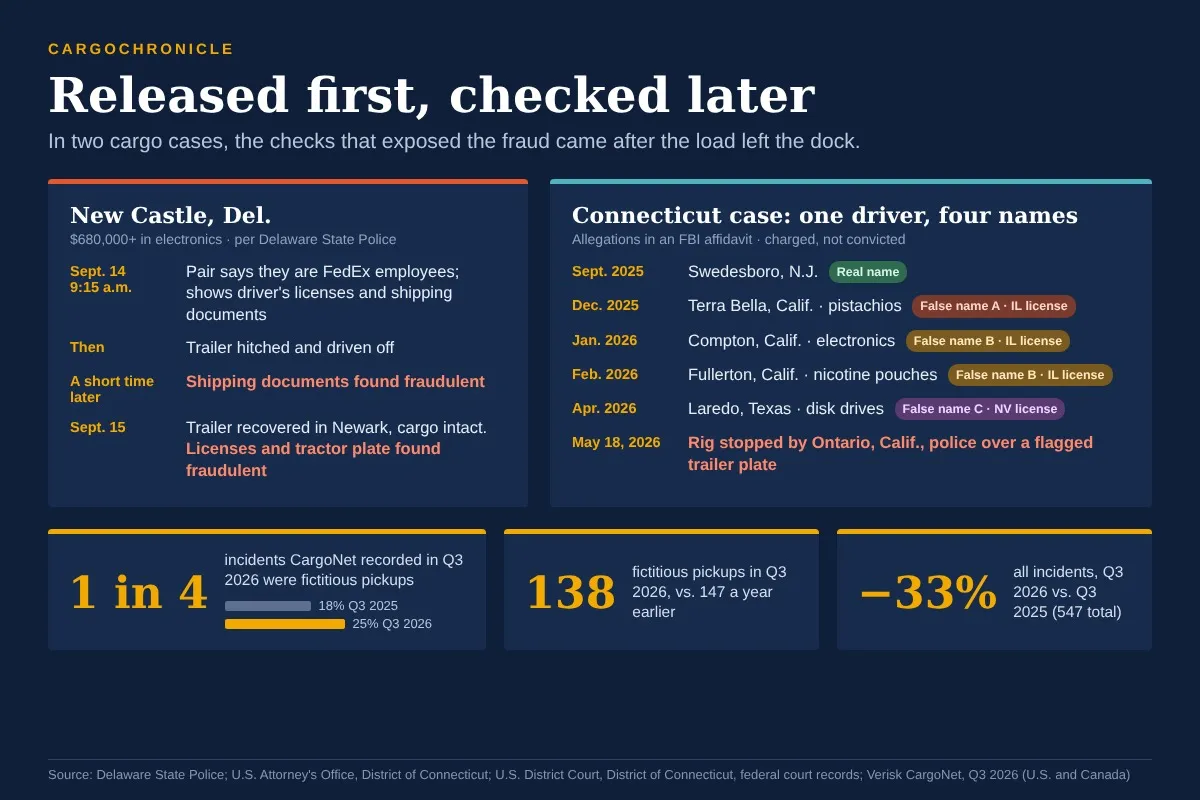
On the morning of Sept. 14, two people pulled up to a business on River Road in New Castle, Del., in a tractor. They said they were FedEx employees and showed driver’s licenses and shipping documents for a trailer holding more than $680,000 in electronics. They hitched the trailer and drove off. According to Delaware State Police, the shipping documents were found to be fraudulent a short time later.
The trailer turned up the next day in Newark with its cargo intact, and one man was charged. But the order of events in the police account is the problem this piece addresses. The papers were presented, the trailer was released, and the fraud was discovered after it left.
What the record shows
New Castle, Del. Police have not described the warehouse’s release procedures, and CargoChronicle does not know what was checked at the dock. What their account does establish is that the licenses shown at the warehouse and the tractor’s registration plate were both fraudulent. Troopers determined that the next day, when they found one of the two men walking back toward the rig.
Connecticut. A commercial truck driver pleaded not guilty on Oct. 21 to a federal conspiracy charge. Prosecutors say the ring he is accused of driving for took over established trucking companies and booked loads in their names. According to an FBI agent’s affidavit, he collected the first load it cites, in Swedesboro, N.J., under his real name. For later pickups in Terra Bella, Compton, Fullerton and Laredo, Texas, the affidavit says he presented counterfeit licenses under three other names, each carrying his own photo with altered features. One Illinois license used a number the state had never issued. Investigators also allege the tractor carried a swapped plate at pickups. The charges are allegations.
In both cases, the decisive facts (a forged license, a false plate, one face under several names) were established by investigators after the freight had gone.
The control
Release should depend on confirming two things through channels the person at the window doesn’t control: who the driver is, and that the carrier actually sent him.
- Call the carrier back. Confirm the driver’s name, tractor plate and trailer number using contact details already on file, never the ones printed on the paperwork being presented.
- Match against the tender. Compare the driver and equipment with what the carrier provided when the load was booked. A mismatch is a stop, not a discrepancy to note and wave through.
- Validate the license by tool, not by eye. Format and barcode checks can catch a number a state never issued. A license that fails is a stop.
- Photograph every release: driver, license, tractor plate and trailer number.
Making it stick
Every added check costs time at the dock, and a check that costs too much gets skipped. Written procedures and training are what keep that cost low. Most of the verification can happen before the truck arrives: when the carrier confirms the driver and equipment at tender, the dock’s job shrinks to a quick match. Staff who have practiced the callback, know what counts as a mismatch and have a script for telling a driver to wait make a hold routine rather than a confrontation.
A check that relies on one dock worker being willing to challenge a driver alone will give way the first time the yard is backed up. So the procedure should name an owner and give dock staff explicit authority to hold a load, with no penalty for the delay. Every shift needs one escalation contact who answers. And someone should periodically sample release records to confirm each check was actually done, not just signed for.
Scaling it
Not every load needs every check, and a procedure that slows every pickup will be worked around. A workable split:
- Every load: the callback, the match against the tender, and release photos.
- High-value or high-theft commodities: enhanced checks, meaning written pre-advisement of the driver and equipment at tender, tool-based license validation and a second sign-off before the trailer moves.
What it won’t catch
Driver checks confirm that the carrier sent this driver. They can’t tell you whether the carrier itself has been compromised. In a Los Angeles case that ended in two convictions in September, prosecutors said the ring bought licensed carriers outright and booked real loads under their names. A carrier in that position will confirm its own driver on a callback. Catching that takes checks on changes in carrier ownership and contacts, a separate control we will take up in a later piece.
The national picture
Fictitious pickups are taking up a larger share of a shrinking problem. Verisk CargoNet counted 138 in the U.S. and Canada in the third quarter of 2026, down from 147 a year earlier. Total incidents fell 33% over the same period, to 547. Fictitious pickups now account for about a quarter of all incidents, up from 18%.
Earlier CargoChronicle coverage: the New Castle fake FedEx pickup, the Connecticut taken-over carrier case and the Los Angeles carrier-purchase ring verdict.
Sources
- Delaware State Police news release, Sept. 18, 2026
Delaware State PoliceAccessed
- U.S. Attorney's Office announcement, Oct. 21, 2026
US Attorney, D. Conn.Accessed
- U.S. District Court, District of Connecticut, federal court records
U.S. District Court, District of ConnecticutAccessed
- U.S. Attorney's Office announcement, Sept. 29, 2026
US Attorney, C.D. Cal.Accessed
- Third-quarter 2026 cargo theft analysis
Verisk CargoNetAccessed