
Plea Deal in $100 Million Brink's Jewelry Theft Sets Up a Fight Over What the Jewelers Declared
A defendant will plead to a knifepoint AirTag robbery, not the jewelry theft. Prosecutors put restitution above $100.3 million; the defense says jewelers declared under $10 million.
RIVERSIDE, Calif. — A defendant in the federal case over the 2022 theft of roughly $100 million in jewelry from a Brink’s trailer has agreed to plead guilty. The count he will admit is not the jewelry theft. Under a plea agreement filed Nov. 9 in federal court in Riverside, he will plead to one count of Hobbs Act robbery: the March 11, 2022, knifepoint theft of Apple AirTags from a box truck in Fontana.
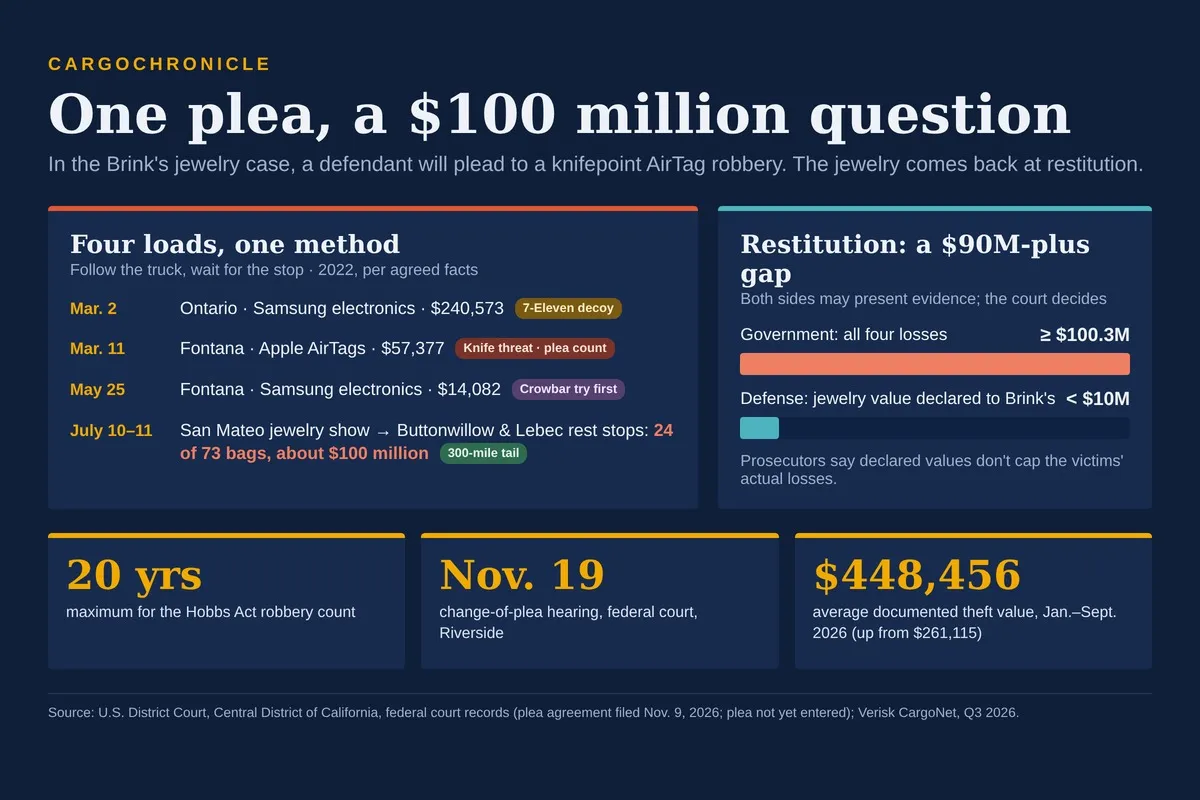
The jewelry is still on the table. Prosecutors will move to dismiss his remaining counts at sentencing, but under the agreement the judge may weigh those charges when setting his sentence and may order restitution for every theft in the indictment. The government puts that figure at no less than $100,312,031.54, the four documented losses added together.
The defense intends to fight most of that number. According to the agreement, he contends that some of the victims declared a combined value of less than $10 million for the jewelry in their transportation contracts with Brink’s. Prosecutors dispute that those declarations limit what the victims actually lost. Each side may put on evidence when the court decides restitution.
A change-of-plea hearing is set for Nov. 19 before U.S. District Judge Kenly Kiya Kato. The plea is not final until the judge accepts it.
Four loads in five months
The facts both sides agreed to describe a group that operated from at least March 2 to July 20, 2022. Its members used several vehicles to trail drivers hauling interstate and foreign freight, waited for the truck to stop, and took cargo from trucks left unattended or, in one case, in front of the driver. The goods went back to Los Angeles County to be divided and sold.
- March 2, Ontario — Samsung electronics, about $240,573: When the driver pulled into a 7-Eleven, members of the group kept him occupied by asking for help translating so they could buy a prepaid phone. One of the decoys stayed on a call with the people unloading the truck.
- March 11, Fontana — Apple AirTags, about $57,377: The box truck was carrying AirTags shipped from China to a Fontana warehouse. While the driver stopped for food, the defendant sat in the van meant to receive the goods and spent 87 minutes on the phone tracking the driver’s movements. When the driver caught the group in the act, one of them held up a small knife and threatened him. This is the count the defendant will plead to.
- May 25, Fontana — Samsung electronics, about $14,081.54: A crowbar break-in at a Pilot Flying J truck stop was abandoned. Later that day the group cut the wrapping on boxes in a semitrailer waiting to be unloaded and took the electronics.
- July 10–11, San Mateo to Kern County — jewelry, about $100 million: After three days of scouting an international jewelry show in San Mateo, the group followed a Brink’s semitruck carrying 73 bags of jewelry about 300 miles south to rest stops at Buttonwillow and Lebec. There they broke the trailer’s locks and took 24 bags. In the days that followed, members of the group shut off the phone numbers they had used.
After the indictment
A grand jury indicted seven men in June 2025, and the case was made public June 17, 2025. According to the agreement, the defendant then searched online for information on a person wanted by police and Interpol and on travel to Mexico, Central America and Canada, and messaged a South American number about crossing the U.S.-Mexico border after a “robo grande.” He was detained on July 1, 2025, at the airport in Panama City, Panama, during a layover on a trip from Guatemala to Ecuador.
What he faces
The robbery count carries up to 20 years in prison, three years of supervised release and a fine of $250,000 or twice the gain or loss, whichever is greater. The parties agreed on a base offense level of 20 for the robbery under the sentencing guidelines but left each side free to argue for further adjustments, and they reached no agreement on his criminal history. Prosecutors will recommend credit for acceptance of responsibility if he keeps accepting it through sentencing.
Of the seven men indicted, the court dismissed the case against one, without prejudice, in February 2026. The others remain charged and are presumed innocent. CargoChronicle does not name people who have not been convicted.
Why it matters
The restitution fight turns on a gap that every shipper of high-value goods should know before a loss, not after: the difference between the value written into the transport contract and the value of what is actually on the truck. Declared value shapes carrier liability, insurance and the security level a load gets. When the two numbers are far apart, the shipper finds out in a claim or a courtroom.
The other lesson is in the pattern. Each of the four thefts began the same way: a loaded truck followed from origin until the driver stopped somewhere public. For high-value freight, that argues for written, enforced procedures covering planned stops, no-stop or team-driver rules, secured parking, drivers trained to notice they are being followed, and an alert when a load stops anywhere off plan.
Theft is getting more expensive per incident. Verisk CargoNet reported Nov. 4 that the average documented value of a stolen load through September 2026 was $448,456, up from $261,115 a year earlier.
CargoChronicle will report on the Nov. 19 hearing and follow the case through sentencing and the restitution decision.
Sources
- U.S. District Court, Central District of California, federal court records
U.S. District Court, Central District of CaliforniaAccessed
- Third-quarter 2026 cargo theft analysis
Verisk CargoNetAccessed