
Stolen Water Pik Load Ends in Two-Year Sentence and an Online-Selling Ban
The court ordered more than $420,000 repaid to the manufacturer itself, and barred the Memphis man from running an online storefront.
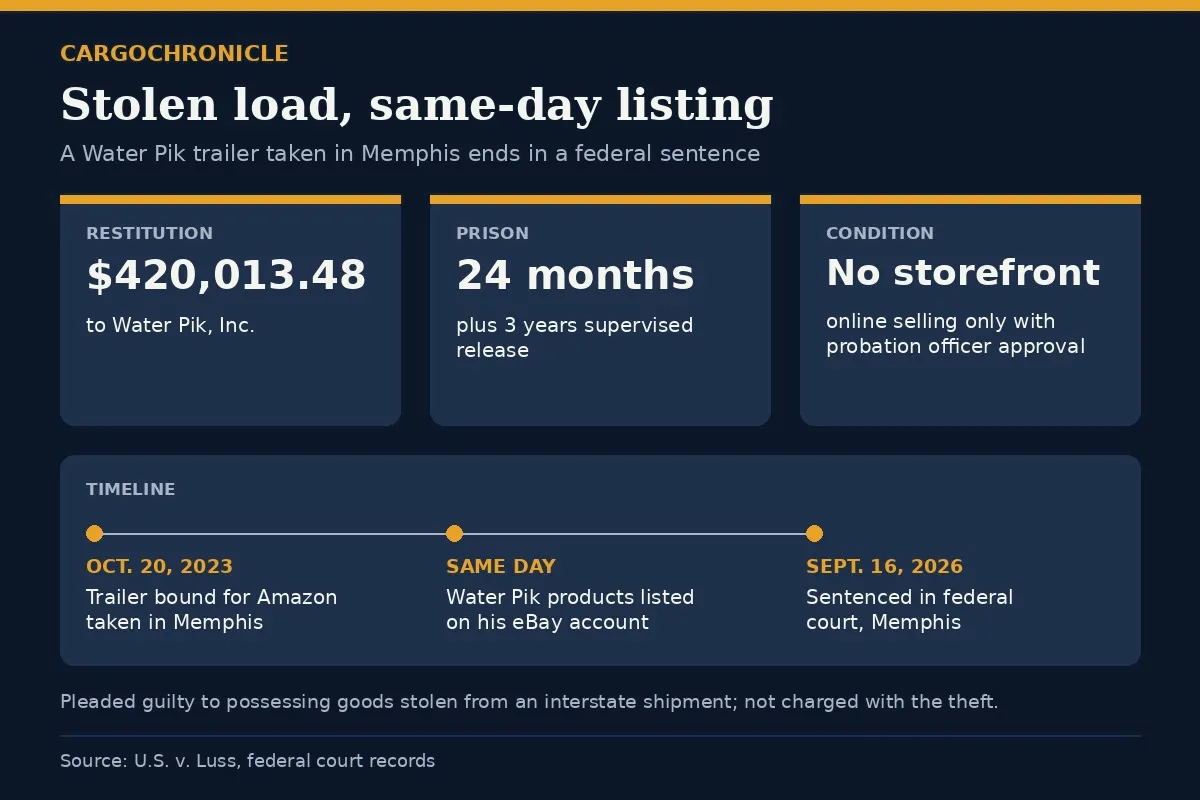
MEMPHIS — A federal judge has ordered a Memphis man to repay Water Pik, Inc. $420,013.48 for a trailer-load of its products stolen in Memphis in 2023. The judge also barred him from selling online without his probation officer’s approval, a condition that reflects how the goods were moved. Gregory Luss was sentenced Sept. 16 to 24 months in federal prison, the maximum the government had agreed to recommend.
Luss pleaded guilty in March to one count of possessing goods stolen from an interstate shipment. He was not charged with taking the trailer, and his plea agreement contains no account of who did. According to prosecutors, the trailer was bound for Amazon when it was taken from a Bledsoe Cove location in Memphis on Oct. 20, 2023. That same day, Luss listed a large inventory of Water Pik products on an eBay account in his own name.
The court judgment dates the end of his offense to Dec. 11, 2023, seven weeks after the theft. Prosecutors say that period included a confrontation in Texas, where he tried to take back products he had sold to a buyer, then struck a warehouse manager and six vehicles while fleeing.
The case moved slowly. Luss was indicted in March 2025, arrested that April, and sentenced nearly three years after the trailer disappeared. Under his plea deal, the government agreed to recommend no more than 24 months, and Luss waived his right to appeal any sentence at or below that cap. His lawyer asked for less. In a sentencing memorandum, he argued that Luss runs a construction and grounds-maintenance business in Memphis and north Mississippi that would fail without him, hurting his ability to pay restitution. U.S. District Judge Thomas L. Parker imposed the full 24 months, plus three years of supervised release.
The supervision terms go well beyond the standard. Luss may not operate an online storefront or seller profile of any kind without his probation officer’s approval. He must give the officer access to all of his financial information and may not open new lines of credit without approval. Restitution is due in monthly payments of at least 10% of his gross income.
The FBI Nashville Field Office’s Cargo Theft Task Force investigated the case.
The national picture
A full trailer taken from a lot is the kind of theft that has been receding nationally. Verisk CargoNet recorded fewer organized thefts of unattended, loaded trailers in the second quarter of 2026. Total incidents across the U.S. and Canada fell 26% from a year earlier, to 677, even as losses more than doubled to $304.6 million.
Why it matters
The restitution order lands on the manufacturer. That is a reminder that the company absorbing a cargo loss is not always the one that lost custody of the freight. The selling ban shows where this case turned: the goods appeared for sale the same day they disappeared. Two measures cover both ends of that timeline. Shippers and carriers can secure staged trailers and report a missing load immediately. Brand owners can watch online marketplaces for sudden surges of their own products.
Sources
- P1U.S. Attorney's Office announcement, Sept. 21, 2026
US Attorney, W.D. Tenn.Accessed
- P1Docket and filings, United States v. Luss, No. 2:25-cr-20057-TLP
US District Court, W.D. Tenn.Accessed
- P1Second-quarter 2026 cargo theft analysis
Verisk CargoNetAccessed